
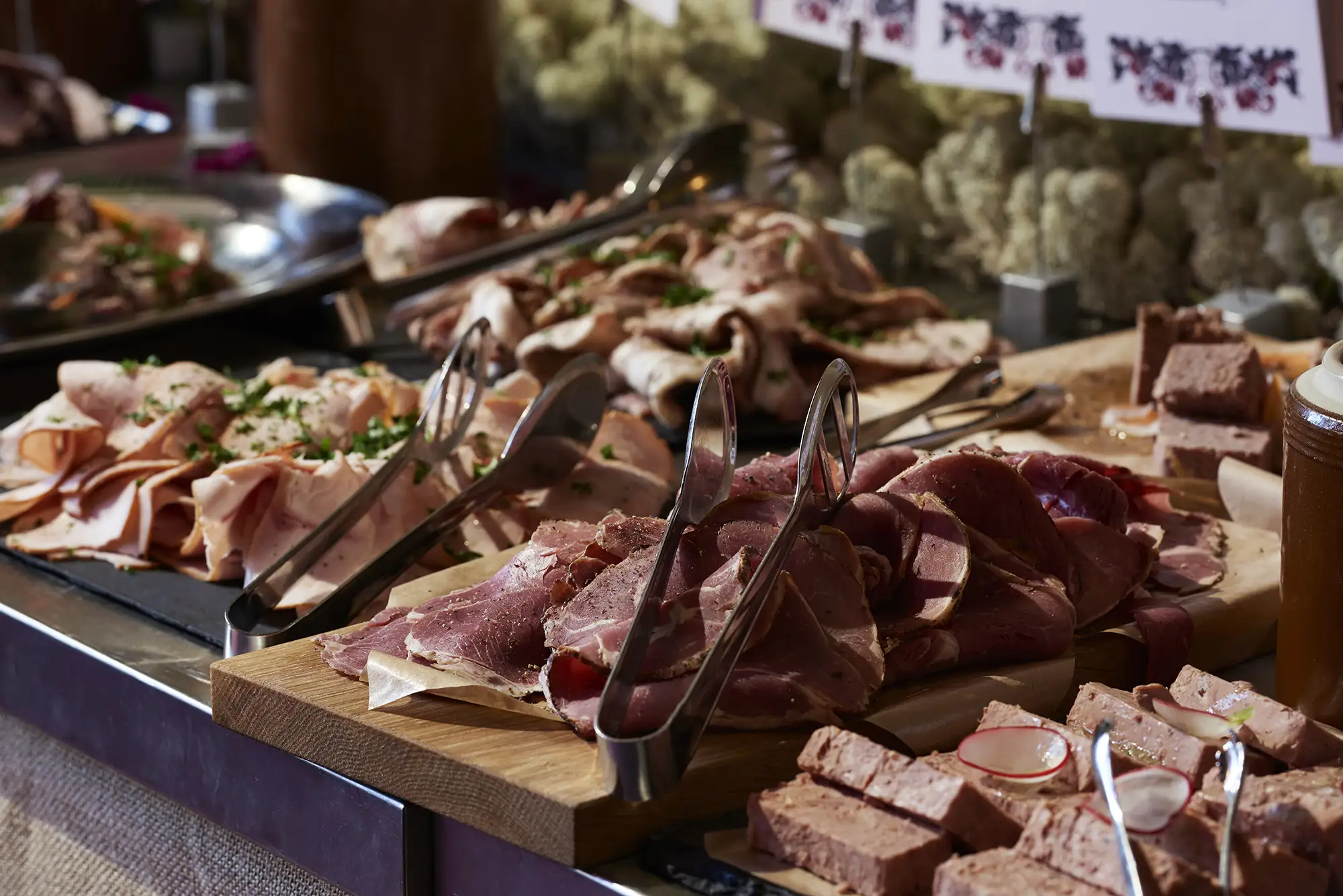
The Swedish Christmas buffet, or julbord, is one of the country’s most beloved traditions—a meal that does more than satisfy hunger; it tells a story of heritage, celebration, and flavor. But what exactly defines a traditional Swedish julbord? In this article, we explore its origins, how it has evolved over the centuries, and which dishes still remain essential on every classic Christmas table.
With this year’s Christmas buffet reservations now open, we’re already starting to explore the concept of the julbord—its history, what we’ll be serving, and much more. But first, let’s begin with what is traditionally considered a Swedish julbord and where the concept itself actually originates.
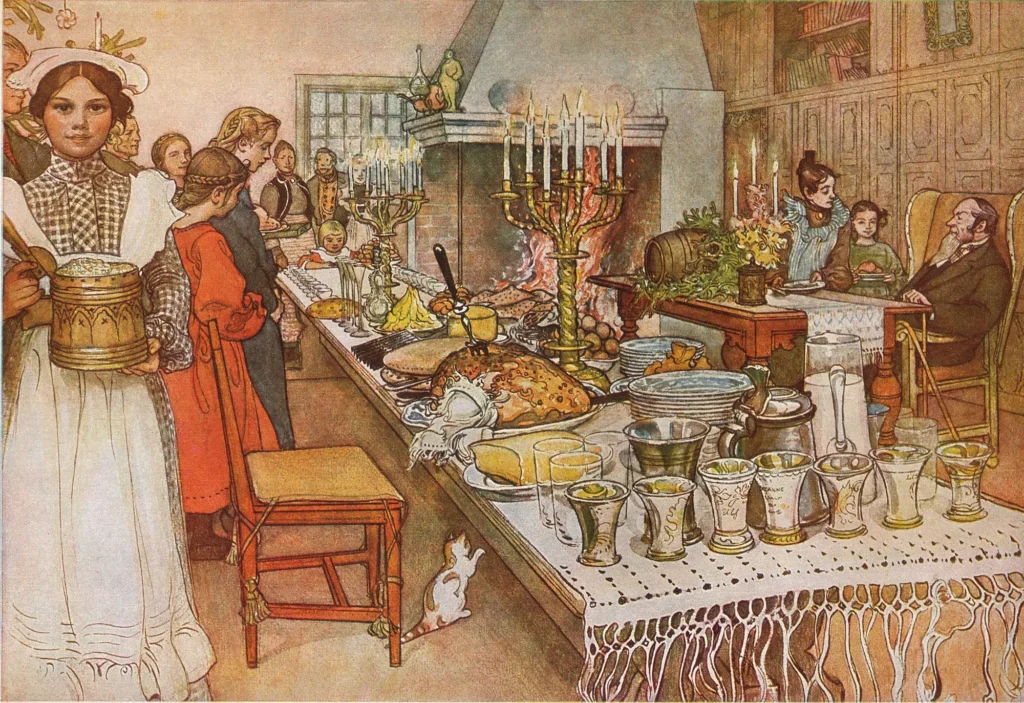
Carl Larsson, Christmas Eve, 1904, watercolor on canvas.
A classic Swedish julbord is a feast for both the eyes and the palate. It features a wide variety of dishes that have been served in Swedish homes for generations. Let’s start with some of the most iconic items that you’ll almost always find at a classic julbord. At Gamla Riksarkivet, we always strive to take the julbord to the next level, but here is the basic (and barely acceptable) standard:
Each of these dishes certainly deserves its own deep dive, but we want to highlight the ham and the herring in particular, as these are two elements we put an extraordinary amount of effort into for our julbord. Returning to what defines a traditional Swedish julbord—the very earliest versions trace back to the Viking midwinter blót of the 11th century, a festival built on brutal sacrificial rituals to the Norse gods. At that time, people spoke of “drinking Yule.” A whole pig would be slaughtered and every part used, which is why dishes like Christmas sausage, head cheese, pigs’ feet, and dopp i grytan likely count among the oldest components of the julbord. By the late 1800s, Sweden and the rest of the world had developed better food preservation methods, leading to dishes like pickled herring, cured or gravlax salmon, and dried meats. This eventually expanded to include a larger number of side dishes such as eggs, fish, and beetroot.

Carl Larsson, Midwinter Sacrifice, 1915, oil mural, Nationalmuseum.
The modern julbord emerged in the early 20th century, when Christmas ham, prince sausage, Jansson’s Temptation, gravlax, and meatballs became common. The artist Carl Larsson depicted several Christmas scenes in his work, including the image you saw at the beginning of this article, Christmas Eve (1904), which likely helped establish the Christmas ham as a signature feature of the Swedish holiday. Before the 1900s, this particular pork cut was one of the finest and typically reserved for summer. Before the ham took center stage, it was customary to serve the pig’s head, a dish called julhös, which we have, in fact, served once before at our julbord at Gamla Riksarkivet.
Eventually, julbord began to be served in restaurants shortly after World War I, usually one or two Sundays before Christmas. Today, just like at our venue, Christmas buffets are already being served as early as November. With that, we conclude our first deep dive into the julbord and Christmas traditions in Sweden. If you’re interested in booking a table with us, the link below will take you to the reservation page
